Tribal and Native American Issues
There are 574 ethnically, culturally, and linguistically diverse federally recognized Indian Tribes in the United States. These Tribal Nations are distinct political entities whose inherent sovereignty predates the United States and is reflected in their government-to-government relationship with the U.S. government. The United States has undertaken a unique trust responsibility to protect and support Tribal Nations and their citizens through treaties, statutes, and historical relations with Tribal Nations. The 2022-2027 Strategic Plan addresses the federal government’s responsibilities to Tribal Nations and their citizens.
In 2018, the U.S. Commission on Civil Rights reported that—due to a variety of reasons such as historical discriminatory policies, insufficient resources, and inefficient federal program delivery—American Indians and Alaska Natives continue to rank near the bottom of all Americans in terms of health, education, and employment.
Several federal agencies provide direct services or funding to federally recognized Tribal Nations and their citizens—including the Bureau of Indian Affairs (BIA), the Bureau of Indian Education (BIE), and the Indian Health Service (IHS). However, they face a number of challenges to improving the effectiveness and efficiency of their tribal programs. Improving federal management of programs that serve Tribal Nations and their citizens is on the High Risk List.
- IHS has faced numerous challenges in administering health care services to American Indians and Alaska Natives. For example, recent cases of provider misconduct, including sexual abuse and physical assault, have raised questions about the agency’s ability to protect patients from harm.
- BIE-funded schools are required to provide services for eligible students with disabilities, such as learning disabilities or health impairments. Each of these students has an individualized education plan outlining the type, frequency, and duration of services the school is legally required to provide—e.g., physical therapy. Schools must log when and for how long the services in each plan are provided to students. However, schools didn’t provide or didn’t log almost 40% of students’ planned service time. Strengthening oversight and support activities can help BIE address the unique needs of students with disabilities.
- Federal agencies are required by law to provide a variety of programs and services to Tribal Nations and their citizens. The Office of Management and Budget publishes an annual report on federal funding for programs that benefit Native Americans but has not developed a formal process to regularly solicit and assess feedback from federal agencies and tribal stakeholders. Additionally, some agencies do not have a formal process for incorporating tribal input and needs into their budgets.
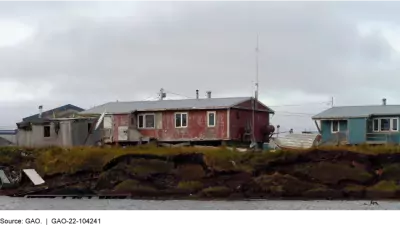
- More than 70 out of over 200 Alaska Native villages face significant threats from erosion, flooding, or thawing permafrost—and climate change is expected to exacerbate these threats. Federal agencies have worked to repair damaged infrastructure in Alaska Native villages and build their resilience to environmental threats. However, federal assistance would be more effective if there was interagency and intergovernmental coordination among federal agencies and state and tribal governments to address these threats.
Erosion and thawing permafrost undermine the land beneath homes in Newtok, Alaska
- Broadband is critical to modern life, but despite federal efforts, broadband access on tribal lands has lagged behind the rest of the country. In 2020, 18% of people living on tribal lands couldn’t access broadband service, compared to 4% of people in non-tribal areas. Numerous federal programs are working to increase broadband access on tribal lands. However, Tribal Nations have struggled to identify which federal program meets their needs and have had difficulty navigating complex application processes.
- Research shows that violence against American Indian and Alaska Native women in the U.S. is a crisis. Cases of missing or murdered Indigenous women persist nationwide, but without more comprehensive case data in federal databases, the full extent of the problem is unknown. The Department of Justice should develop a plan—including key steps, who will achieve them, and by when—for accomplishing ongoing analyses of data in existing federal databases (as well as future data that may be gathered) to identify relevant trends in these cases.
- Demand for homeownership is high on reservations and other tribal areas, but access to mortgage loans may be limited. The Department of Veterans Affairs (VA) operates the Native American Direct Loan program to provide loans to eligible Native American veterans to purchase, construct, or improve homes on certain types of land. However, the VA has made relatively few loans under this program.
- Native American human remains and cultural items—including pottery, weapons, and sacred objects—have long been the target of theft by individuals seeking to collect or sell them. Several federal agencies manage or administer publicly accessible federal and Indian lands that contain Native American cultural resources, but various factors (such as limitations with data to support decision-making) hinder agency efforts to prevent the theft and damage of these resources. In addition, agencies have faced challenges proving violations of existing U.S. laws when Tribal Nations seek to repatriate items that have been taken without their consent and auctioned overseas.
Recent Reports
Indian Health Service: Actions Needed to Improve Use of Data on Adverse Events
